Yorkville Branch of the New York Public Library
The ChangelingThe Yorkville Branch of the New York Public Library is where Apollo Kagwa, newly released from Rikers Island and required to attend group therapy as a condition of parole, spends his first evening outside prison. The branch gives him a circle of people who can hear what he has done and a public place in which to postpone going home; it cannot make that company last beyond the meeting or the library’s closing time.
Setting and Arrival
Apollo reaches the branch on East 79th Street slightly early. The surrounding block seems unusually genteel by Manhattan standards: a broad street with a view west to the Hudson River, apartment buildings of only twenty or thirty stories, and an air of quaintness that, the narration observes, takes considerable money to produce. The library itself is an elegant townhouse and a New York City landmark, its measured, settled appearance sharply at odds with Apollo’s uncertainty about being there.
He stands on the sidewalk staring up at the building, visibly out of place. Men deliberately give him their elbows, while mothers push past with strollers. His visit is not casual: the Manhattan district court has made attendance a vital aspect of his parole. The public building thus becomes, at once, an institution he must enter and a refuge he has chosen to seek before facing the private space he is avoiding.
The Survivors Meeting
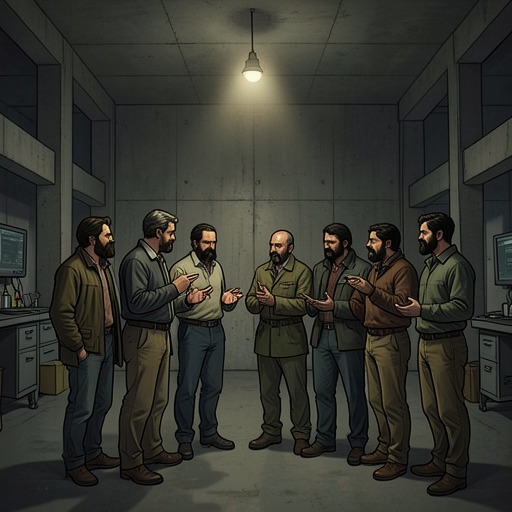
The meeting takes place in the branch’s basement event space, which can seat seventy-two. Only twelve people are present that evening, seated in a circle. A tall woman notices Apollo approaching and waves him over with the practiced authority of someone accustomed to guiding people who are vulnerable or confused. The group calls itself the Survivors, and she welcomes him as the meeting gets underway.
Apollo initially understands the gathering as court-ordered group therapy. As the others speak, he compares its atmosphere to an AA meeting, as he has encountered such meetings on television and in films. More than half the participants seem to be struggling with drugs, but their stories do not center on the harmful things they did while intoxicated. Instead, they return to the gap between a catastrophe and the person left alive after it. The group’s name begins to seem inadequate to Apollo: its members have survived in the literal sense, yet their accounts suggest that survival has not restored them to ordinary life.
Apollo’s First Account
Apollo remains quiet while the others speak. When he does take his turn, he tells the group that this is his first meeting, that he was released from Rikers Island before sunrise, and that he met his parole officer that afternoon after waiting two hours. He presents the day as a sequence of enforced appointments, ending in the basement circle. The other members listen without responding immediately; Alice asks whether the parole officer really required him to attend on the same day he was released.
The officer had, in fact, encouraged Apollo to go home, shower, and rest. Apollo had instead asked for help finding a meeting right away. The distinction matters: he is not simply complying with a directive to appear. He wants to avoid stepping back into his apartment, but cannot explain that motive to the group. The meeting therefore receives only a partial account of his immediate need. His words establish the circumstances of his release, while his choice to seek a room of strangers reveals how urgently he wants not to be alone with the home awaiting him.
Closing Time and the Return Home
After the session ends, Apollo stays in the library until it closes at seven. He sits on the main floor near the checkout desk with a magazine in his lap. Speaking about what he has done has not relieved him; immediately after the meeting, he feels worse. During the session he had at least been among people whose lives had also been altered by catastrophe. Once it is over, the ordinary Wednesday evening resumes, and each person is left alone again.
One member’s story stays with him: a man with a gray beard had been texting when he rolled into an intersection, where a moving truck smashed his car. His fiancée was dead before the car stopped spinning. That account gives concrete form to the group’s recurring divide between the terrible event and the person who remains to live afterward. Yet hearing such stories does not supply Apollo with a way through his own next hours. He doubts that he can endure six months of this routine, but knows that failing to attend could send him back to Rikers Island, without a quick release date to secure.
In the chair, he tries to talk himself into tolerance, tenacity, and recovery. Eventually, the library can offer no further delay: he has to go to the apartment. As he reaches his block, enters the building, and rides the elevator, he keeps expecting someone to leap out and stop him. No one does. At the apartment door he hesitates, then slides his keys into the locks. The branch’s significance lies in this temporary interval: it gives Apollo a circle in which other people’s survival can be spoken aloud, but its closing hour returns him to the solitude he had come there to postpone.